vpFREE2 Forums

Risk of Ruin Before Royal

Steve Jacobs wrote:

>Dan wrote:

Both of our methods necessarily assume that lesser payoffs occur in
the expected frequency, so a simulation may be more accurate than
either method.

No. A simulation can't be more accurate than "exact".

But it can be used to determine whether the "exact" calculation is, in fact, exact.

When I say "exact" I really mean it. You aren't grasping what I'm trying
to tell you. My method is NOT an approximation. It is exact, in the same
way that solving the equation that you call the "Sorokin equation" gives
an exact solution for risk of ruin.

In the Sorokin formula, Risk is a function of itself, thus requiring an iterative procedure for its solution. I don't see how a similar problem can be solved without a similar iterative procedure.

> Since the Poisson Distribution formula has been accepted by

mathematicians for nearly 200 years, I am confident that my method is
accurate enough provided your bankroll is sufficient to play at least
one cycle without hitting a royal. (For this reason, Optimum Video
Poker does not do this calculation for smaller bankrolls.)

Solving the "Sorokin equation" gives a solution that is exact for any
size bankroll. My method uses the same approach, but adjusted for
probability of royal.

Your method does not involve Risk being a function of itself, so it is not "the same approach."

> I wrote a Risk of Ruin by simulation program several years ago and

ran it for 9/6 JoB, 10/7 DB and FPDW. The results were published in
Video Poker Times and currently in All The Best of Video Poker Times.
Readers may want to compare the results of the Sorokin formula with
those simulations.

If those simulations don't track well with the "Sorokin formula" then the
simulations are flawed. I'm assuming they do track.

Thanks. Yes, they do.

Sorokin doesn't really deserve credit for this, since the same method
was used by Laplace, De Moivre, Lagrange and Bernoulli, hundreds
of years ago.

Then why did not someone come up with a single formula for games with a wide range of probabilities and payoffs before Sorokin?

> I'll see if I can find that program. If I can, it

shouldn't be hard to modify it to stop on a royal.

That would be great. I may be able to modify one of my VP programs
to do similar simulations. I trust that the simulations will back up my
claims.

They may, or they may not back anyone's theoretical calculations.

Dan

···

--
Dan Paymar
Author of best selling book, "Video Poker - Optimum Play"
Editor/Publisher of VP newsletter "Video Poker Times"
Developer of VP analysis/trainer software "Optimum Video Poker"
Visit my web site at www.OptimumPlay.com

"Chance favors the prepared mind." -- Louis Pasteur

Steve Jacobs wrote:
> >Dan wrote:
>>
>> Both of our methods necessarily assume that lesser payoffs occur in
>> the expected frequency, so a simulation may be more accurate than
>> either method.
>
>No. A simulation can't be more accurate than "exact".

But it can be used to determine whether the "exact" calculation is,
in fact, exact.

It can certainly be used to determine which of two significantly different
answers are more likely to be correct. However, there isn't enough
simulation power on the planet to confirm/deny the 15th decimal
place of an exact calculation. In addition, simulation breaks down
when extreme accuracy is required, because random number generators
are never perfect. So, technically, simulation can never be quite as
good as an exact calculation.

>When I say "exact" I really mean it. You aren't grasping what I'm trying
>to tell you. My method is NOT an approximation. It is exact, in the same
>way that solving the equation that you call the "Sorokin equation" gives
>an exact solution for risk of ruin.

In the Sorokin formula, Risk is a function of itself, thus requiring
an iterative procedure for its solution. I don't see how a similar
problem can be solved without a similar iterative procedure.

I never claimed that my solution didn't require an iterative procedure.
I've posted my equations in a response to Michael Peck. My equation
is almost identical to the equation for Risk of Ruin. The only difference
is the term for the royal flush. It is still a recursive equation, so it
does require an iterative solution.

> > Since the Poisson Distribution formula has been accepted by
>>
>> mathematicians for nearly 200 years, I am confident that my method is
>> accurate enough provided your bankroll is sufficient to play at least
>> one cycle without hitting a royal. (For this reason, Optimum Video
>> Poker does not do this calculation for smaller bankrolls.)
>
>Solving the "Sorokin equation" gives a solution that is exact for any
>size bankroll. My method uses the same approach, but adjusted for
>probability of royal.

Your method does not involve Risk being a function of itself, so it
is not "the same approach."

That is dead wrong. Here's my equation again:

F = p(lose) + p(1)*F + p(2)*F^2 + ... + p(50)*F^50

Look familiar? F is the probability of starting with a one unit bankroll
and going bust without ever hitting a royal. Note the lack of a term
for the payoff of a royal. That's what makes this a "risk of no royal"
equation rather than a "risk of not playing forever" equation. The
risk of no royal depends only on the other payoffs.

This whole discussion took a different turn than I had anticipated.
I haven't seen your article on computing probability of royals,
since I don't subscribe. I figured you had probably followed the
same path that I took, using a Sorokin-like equation, and the most
likely outcome would be that my numbers would match yours. I've
been working with "best-shot at royal" strategies for over a year.

Similar equations can be used for other payoffs. For example, to find
the probability of eventually hitting 4/kind, you can start with the
Risk of Ruin equation and remove the terms for the 4/kind payoff.
For 9/6 JoB, this leads to F = 0.97773237412 when using max-EV
strategy. This gives a 1/44.9 chance of hitting 4/kind when starting
with a single unit bankroll. To have a 50% chance of hitting 4/kind,
one needs a bankroll of 31 units. A strategy that is optimized for
surviving until hitting 4/kind can improve this to 1/43.7720, reducing
the 50/50 bankroll to 30 units.

>Sorokin doesn't really deserve credit for this, since the same method
>was used by Laplace, De Moivre, Lagrange and Bernoulli, hundreds
>of years ago.

Then why did not someone come up with a single formula for games with
a wide range of probabilities and payoffs before Sorokin?

If you haven't seen it elsewhere, perhaps you've looked in the wrong
places. Gambling literature is the wrong place to look. Try math books
that discuss Markok chains and/or random walks.

> > I'll see if I can find that program. If I can, it
>>
>> shouldn't be hard to modify it to stop on a royal.
>
>That would be great. I may be able to modify one of my VP programs
>to do similar simulations. I trust that the simulations will back up my
>claims.

They may, or they may not back anyone's theoretical calculations.

True. It is possible that we are both wrong. It isn't possible that we
are both right, since there is a big gap between our answers. The
important thing isn't really who is right and who is wrong, the important
thing is to find the truth and move forward with a better understanding
of how these things work.

I believe that if you'll give some serious thought to using a Sorokin-like
equation, you'll realize that it is the correct approach and that it gives
an exact solution.

···

On Sunday 06 November 2005 07:44 am, Dan Paymar wrote:

> But it can be used to determine whether the "exact" calculation is,

> in fact, exact.

It can certainly be used to determine which of two significantly

different

answers are more likely to be correct. However, there isn't enough

OK, I did the simulation. It took a little longer than I would have
liked because the statistics oriented language I prefer to use for
exercises like this is interpreted and too slow for this exercise, so
I had to dust off my rudimentary C programming skills.

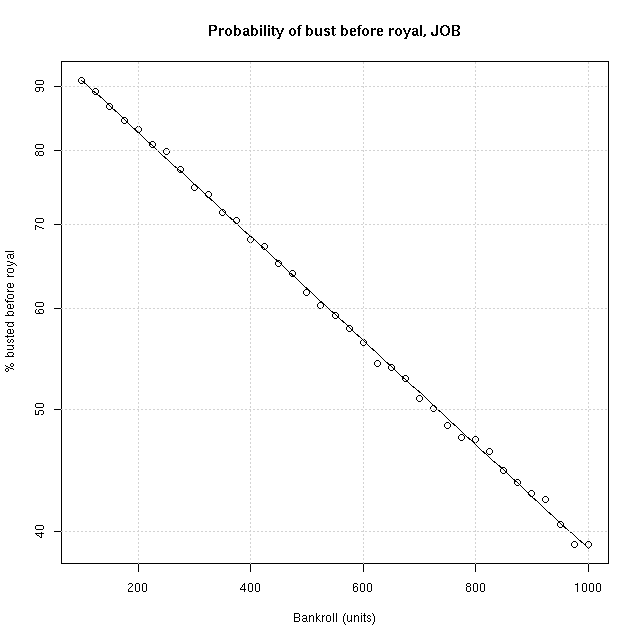
Here's a graph of the results:
<http://www.wildlife-pix.com/vpoker/fbust.png>. This shows the
percentage of busts without a royal for JOB for bankrolls between 100
and 1000 units (500 and 5000 coins). The simulation used a sample size
of 10,000. The straight line gives the theoretical "exact" values
using Steve's analysis.

His analysis and results still look right to me.

Here's a table of partial results:

B'roll MC_bust Theo_bust

···

--- In vpFREE@yahoogroups.com, Steve Jacobs <jacobs@x...> wrote:

On Sunday 06 November 2005 07:44 am, Dan Paymar wrote:

------------------------
675 0.529 0.528
700 0.509 0.515
725 0.501 0.503
750 0.485 0.492
775 0.475 0.480
800 0.473 0.469

The scatter around the theoretical exact value in the simulation
should be about +- 0.005, which is just about what I actually got.

By the way I'd never heard of the Sorokin formula until it came up in
this thread and I didn't actually Google it until this morning. Some
guy named Dan Paymar wrote the best article I found on the subject ;).
What Steve did was a straightforward modification of the Sorokin
formula. If you believe it his results shouldn't be too hard to swallow.

Mike

Just in case anyone wants to verify that I didn't cheat or make a huge
mistake, I uploaded my C Monte Carlo code to
<http://www.wildlife-pix.com/vpoker/bustorroyal.c>. Don't look for
elegant programming: this is strictly quick and dirty coding. The file
uses Unix line breaks; if you look at it on a Windows PC use Wordpad
or a programmer's editor.

Mike

> >Sorokin doesn't really deserve credit for this, since the same

method

> >was used by Laplace, De Moivre, Lagrange and Bernoulli, hundreds
> >of years ago.
>
> Then why did not someone come up with a single formula for games

with

> a wide range of probabilities and payoffs before Sorokin?

If you haven't seen it elsewhere, perhaps you've looked in the

wrong

places. Gambling literature is the wrong place to look. Try math

books

that discuss Markok chains and/or random walks.

The fact that some mathematicians understood the equation a hundred
years ago doesn't negate the contribution of someone who first
understands how it can be used to solve video poker RoR problems.
People had been discussing video poker RoR for years without anyone
stumbling on the "polynomial risk equation" and how it could be
applied to VP.

However, the person who deserves credit for first applying the
polynomial risk equation to video poker was jazbo, not Sorokin.

Jazbo re-discovered the polynomial risk equation and showed in an
email to his listserv group in December of 1998 that he understood
how it could be used to solve video poker RoR problems.

Sorokin's contribution was some posts on bjmath.com in early 1999 in
which he independently came up with the polynomial risk equation.
Those posts were ignored for more than a month, because no one
understood what Sorokin had written, and perhaps because he had not
mentioned application to any kind of casino game. I finally had a
Eureka experience and explained Sorokin's post more fully on the
bjmath Workshop forum, including how it could be applied to video
poker. That led to the article that I wrote with MathBoy in
BlackJack Forum in 1999:

http://blackjackforumonline.com/content/VPRoR.htm

MathBoy and I were unaware of jazbo's work with the polynomial risk
equation (it was not on his website), so we mistakenly gave Sorokin
credit for re-discovering it. Dan Paymar propagated our error by
also giving Sorokin credit in his late 1999 article in Card
Player. However, it's clear that jazbo was the first to use the
polynomial risk equation to understand video poker RoR, and IMO, he
deserves huge kudos for doing so.

I believe that if you'll give some serious thought to using a

Sorokin-like

equation, you'll realize that it is the correct approach and that

it gives

an exact solution.

I agree, but let's make that a "jazbo-like equation". ;>)

btw, I think Dan Paymar was the first to publish a game analysis
using the "jazbo-like equation". He analyzed Deuces Wild in the
March/April 1999 edition of Video Poker Times, scooping MathBoy and
my article by a few months.

--Dunbar

Mike,

Thanks for taking the time to run these simulations and post the results.
It is good to know that I'm probably not completely out in left field :wink:

···

On Sunday 06 November 2005 12:49 pm, Michael Peck wrote:

--- In vpFREE@yahoogroups.com, Steve Jacobs <jacobs@x...> wrote:
> On Sunday 06 November 2005 07:44 am, Dan Paymar wrote:
>> > But it can be used to determine whether the "exact" calculation is,
> >
> > in fact, exact.
>
> It can certainly be used to determine which of two significantly

different

> answers are more likely to be correct. However, there isn't enough

OK, I did the simulation. It took a little longer than I would have
liked because the statistics oriented language I prefer to use for
exercises like this is interpreted and too slow for this exercise, so
I had to dust off my rudimentary C programming skills.

Here's a graph of the results:
<http://www.wildlife-pix.com/vpoker/fbust.png>. This shows the
percentage of busts without a royal for JOB for bankrolls between 100
and 1000 units (500 and 5000 coins). The simulation used a sample size
of 10,000. The straight line gives the theoretical "exact" values
using Steve's analysis.

His analysis and results still look right to me.

Here's a table of partial results:

B'roll MC_bust Theo_bust
------------------------
675 0.529 0.528
700 0.509 0.515
725 0.501 0.503
750 0.485 0.492
775 0.475 0.480
800 0.473 0.469

The scatter around the theoretical exact value in the simulation
should be about +- 0.005, which is just about what I actually got.

By the way I'd never heard of the Sorokin formula until it came up in
this thread and I didn't actually Google it until this morning. Some
guy named Dan Paymar wrote the best article I found on the subject ;).
What Steve did was a straightforward modification of the Sorokin
formula. If you believe it his results shouldn't be too hard to swallow.

Mike

vpFREE Links: http://members.cox.net/vpfree/Links.htm

Yahoo! Groups Links

All the math makes my head spin (actually just a tad,
I am a math major).

So I'd love to see what the bankroll should be for
NSUD, 5 play with about a .4% cash back.

I roughed it out and get about 1 royal for the
baseline, and an additional .28% of a royal for each
additional line I play.

So I get about 2.3 royals, or about 9200 bet units.
How close is this to you all? Does this get about an
90-95% confidence factor? Or is the cashback so slim
that the bankroll must be radically higher?

Is this the type of analysis the new Frugal or the new
Dancer endorsed software will provide?

Will the new software packages be available on PC, Mac
and maybe a PDA or two?

···

__________________________________
Yahoo! FareChase: Search multiple travel sites in one click.
http://farechase.yahoo.com

> > >Sorokin doesn't really deserve credit for this, since the same

method

> > >was used by Laplace, De Moivre, Lagrange and Bernoulli, hundreds
> > >of years ago.
> >
> > Then why did not someone come up with a single formula for games

with

> > a wide range of probabilities and payoffs before Sorokin?
>
> If you haven't seen it elsewhere, perhaps you've looked in the

wrong

> places. Gambling literature is the wrong place to look. Try math

books

> that discuss Markok chains and/or random walks.

The fact that some mathematicians understood the equation a hundred
years ago doesn't negate the contribution of someone who first
understands how it can be used to solve video poker RoR problems.
People had been discussing video poker RoR for years without anyone
stumbling on the "polynomial risk equation" and how it could be
applied to VP.

However, the person who deserves credit for first applying the
polynomial risk equation to video poker was jazbo, not Sorokin.

Jazbo re-discovered the polynomial risk equation and showed in an
email to his listserv group in December of 1998 that he understood
how it could be used to solve video poker RoR problems.

That's interesting. I wish Jazbo had published this or placed it on his
web site. It was only about three years ago that I started working
with exact risk equations for VP. I've learned a lot from exploring it
in my own strange way, and it might have been better if I had started
that journey sooner. Oh well.

Sorokin's contribution was some posts on bjmath.com in early 1999 in
which he independently came up with the polynomial risk equation.
Those posts were ignored for more than a month, because no one
understood what Sorokin had written, and perhaps because he had not
mentioned application to any kind of casino game. I finally had a
Eureka experience and explained Sorokin's post more fully on the
bjmath Workshop forum, including how it could be applied to video
poker. That led to the article that I wrote with MathBoy in
BlackJack Forum in 1999:

The Workshop archives seem to be broken. I hope they aren't entirely
lost, since I'd like to review what you wrote back then.

http://blackjackforumonline.com/content/VPRoR.htm

MathBoy and I were unaware of jazbo's work with the polynomial risk
equation (it was not on his website), so we mistakenly gave Sorokin
credit for re-discovering it. Dan Paymar propagated our error by
also giving Sorokin credit in his late 1999 article in Card
Player. However, it's clear that jazbo was the first to use the
polynomial risk equation to understand video poker RoR, and IMO, he
deserves huge kudos for doing so.

> I believe that if you'll give some serious thought to using a

Sorokin-like

> equation, you'll realize that it is the correct approach and that

it gives

> an exact solution.

I agree, but let's make that a "jazbo-like equation". ;>)

btw, I think Dan Paymar was the first to publish a game analysis
using the "jazbo-like equation". He analyzed Deuces Wild in the
March/April 1999 edition of Video Poker Times, scooping MathBoy and
my article by a few months.

Thanks for the historical perspective.

···

On Monday 07 November 2005 02:32 am, dunbar_dra wrote:

Mark Marsh wrote:

All the math makes my head spin (actually just a tad,
I am a math major).

So I'd love to see what the bankroll should be for
NSUD, 5 play with about a .4% cash back.

I roughed it out and get about 1 royal for the
baseline, and an additional .28% of a royal for each
additional line I play.

So I get about 2.3 royals, or about 9200 bet units.
How close is this to you all? Does this get about an
90-95% confidence factor? Or is the cashback so slim
that the bankroll must be radically higher?

I think you're in the ballpark ... I figure about 8800 bet units, but
I'm hardly one of the hard core math pros here and am likely on weaker
ground than you (I ran through about 2/3 of my math major before
switching horses to Econ).

My sources for the calculation are Cindy Liu's "VP Analyzer" to
determine single line bankroll:
http://gamblingtools.net/vp/vpanalyzer.html

and Jazbo Burns' n-play video poker analysis article:
http://jazbo.com/videopoker/nplay.html

···

------------

Cindy Liu's calculator (with the DW paytable reset to NSUD and cb
input as .004) yields a single line 5% ROR bankroll requirement of
29586 bets.

Per Jazbo's site, n-play bankroll requirement for a game should be
linearly proportional to variance, where n-play variance can be
calculated as single play variance + (n-1) covariance.

Jazbo provides game covariance for FPDW as 3.14. Since the variance
of NSUD is within 1% of that of FPDW, I'm willing to use this as a
proxy for NSUD covariance. 5-play NSUD covariance works out to be
about 38.3 (vs. 25.8 for single play)

That's roughly an increase of 1.5x the single play variance. So,
before adjusting for bet size, the 5% ROR bankroll requirement now
becomes 44000 bets. However, that's expressed in terms of the single
play bet. Divided by 5 to reflect the full wager size, that becomes
8800 bet units.

------------

If I'm on my game here (and I'm sure the serious math heads will
correct me if not) then you're in good shape.

But it's critical to remember that these numbers reflect perfect play.
If you're playing modestly off the mark (say .1% error cost), then
the bankroll requirement increases by a factor of 4.6x!

As your posts suggests, when playing so close to breakeven (rather
than with a far more comfortable margin of .5%-1%), things get very dicey.

Is this the type of analysis the new Frugal or the new
Dancer endorsed software will provide?

Frugal doesn't calculate bankroll requirements. I have cause to
expect that it's unlikely that the new product in the offing will.

While I'm not directly familiar with the product, Dan Paymar's Optimum
Video Poker software does have a bankroll calculation. I don't know
if it has an extension that handles n-play.
http://www.advantageplayer.com/videopoker/index.html?optimumplay

- Harry

> The fact that some mathematicians understood the equation a

hundred

> years ago doesn't negate the contribution of someone who first
> understands how it can be used to solve video poker RoR problems.
> People had been discussing video poker RoR for years without

anyone

> stumbling on the "polynomial risk equation" and how it could be
> applied to VP.
>
> However, the person who deserves credit for first applying the
> polynomial risk equation to video poker was jazbo, not Sorokin.
>
> Jazbo re-discovered the polynomial risk equation and showed in an
> email to his listserv group in December of 1998 that he

understood

> how it could be used to solve video poker RoR problems.

That's interesting. I wish Jazbo had published this or placed it

on his

web site. It was only about three years ago that I started

working

with exact risk equations for VP. I've learned a lot from

exploring it

in my own strange way, and it might have been better if I had

started

that journey sooner. Oh well.

What led you to the "exact risk equations"? (ie, what I'm calling
the "polynomial risk equation" or "jazbo-type risk equations") Was
it (1) a result of reading math books, (2) a result of something
published in the gambling literature, or (3) did you figure it out
yourself?

> Sorokin's contribution was some posts on bjmath.com in early

1999 in

> which he independently came up with the polynomial risk equation.
> Those posts were ignored for more than a month, because no one
> understood what Sorokin had written, and perhaps because he had

not

> mentioned application to any kind of casino game. I finally had

a

> Eureka experience and explained Sorokin's post more fully on the
> bjmath Workshop forum, including how it could be applied to video
> poker. That led to the article that I wrote with MathBoy in
> BlackJack Forum in 1999:

The Workshop archives seem to be broken. I hope they aren't

entirely

lost, since I'd like to review what you wrote back then.

Maybe Richard Reid still has access to it. If not, I have hard
copies of most of the relevant posts. However, I'm 1/4 through a
year in Germany (my wife's Sabbatical) and won't have access to my
own records until next summer. Remind me then!

> http://blackjackforumonline.com/content/VPRoR.htm
>
> MathBoy and I were unaware of jazbo's work with the polynomial

risk

> equation (it was not on his website), so we mistakenly gave

Sorokin

> credit for re-discovering it. Dan Paymar propagated our error by
> also giving Sorokin credit in his late 1999 article in Card
> Player. However, it's clear that jazbo was the first to use the
> polynomial risk equation to understand video poker RoR, and IMO,

he

> deserves huge kudos for doing so.
>
> > I believe that if you'll give some serious thought to using a
>
> Sorokin-like
>
> > equation, you'll realize that it is the correct approach and

that

>
> it gives
>
> > an exact solution.
>
> I agree, but let's make that a "jazbo-like equation". ;>)
>
> btw, I think Dan Paymar was the first to publish a game analysis
> using the "jazbo-like equation". He analyzed Deuces Wild in the
> March/April 1999 edition of Video Poker Times, scooping MathBoy

and

> my article by a few months.

Thanks for the historical perspective.

You're welcome.

--Dunbar

All the math makes my head spin (actually just a tad,
I am a math major).

So I'd love to see what the bankroll should be for
NSUD, 5 play with about a .4% cash back.

I roughed it out and get about 1 royal for the
baseline, and an additional .28% of a royal for each
additional line I play.

So I get about 2.3 royals, or about 9200 bet units.
How close is this to you all? Does this get about an
90-95% confidence factor? Or is the cashback so slim
that the bankroll must be radically higher?

Is this the type of analysis the new Frugal or the new
Dancer endorsed software will provide?

Will the new software packages be available on PC, Mac
and maybe a PDA or two?

Let me work backwards. I don't know about the Frugal or Dancer
software, but I have put together a video poker RoR program that
will be available next month. It will do RoR/bankroll calculations
for 25 packaged single-line video poker variations with room for 50
more custom games. The RoR/bankroll calcs will be exact for the
longterm (using the "jazbo-type" polynomial risk equation), and will
take into account tips, cashback, error-rate, and lost taxes. My
program will also do short-term (or "Trip") risk-of-ruin calcs.
(Again taking into account tips, cashback, etc) For example, you
can find out how much bankroll you need to bring with you for a
weekend of NSUD play. The program will run on any PC with EXCEL.

You mentioned a NSUD game with 0.4% cashback. Here is a table of
bankroll vs RoR for the single-line version generated by my program:

% RoR Bankroll
25% 13,700
20% 15,900
15% 18,750
10% 22,750
5% 29,600
2% 38,650
1% 45,500
0.5% 52,350
0.1% 68,250
0.01% 91,000

The 5% number (29,600) agrees with what Harry Porter found using the
Liu program. (My numbers are rounded up to the nearest 50.)

Okay, here's a question: How much of that 29600 do you need to
bring with you on a weekend trip where you intend to play 15 hours
of NSUD? That's a question my program can answer: If you play 500
hands/hr for 15 hours, you need a bankroll of just 585 plays to have
just a 5% chance of going broke. Good, you can leave the other
29015 units (or plays) at home earning interest! (btw, 19% of the
time you
will be 500 plays ahead at some point during the 15
hours.)

Here's another question. What happens if you intend to tip 20
units for a royal? Longterm you would now need 45150 units to have
the same 5% RoR (compared to 29600 with no tipping). But short-term
there is almost no difference. You would still have about a 5%
chance of ruin if you brought 585 units for a 15-hr weekend trip.

What if you make errors that amount to 0.25 units per hour? (Be
sure you test yourself on WinPoker before saying that's too high!
I'm willing to bet it's too low for 95% of players.) With no
tipping but making 0.25 units of error each hour, you need 48850 as
a longterm bankroll. With the same 20-unit tip for a royal as
above, you'd need 115,800 as a longterm bankroll. (The 585-
play "Trip bank" remains sufficient even with when both tips and
errors are included).

That's probably way more (and in some parts, way less) info than you
wanted, but I'm just having some fun with my program.

--Dunbar

···

--- In vpFREE@yahoogroups.com, Mark Marsh <butnpushr@y...> wrote:

__________________________________
Yahoo! FareChase: Search multiple travel sites in one click.
http://farechase.yahoo.com

Thank you very much, it makes a lot of sense. I
particularly like the session vs total bankroll
component of your program!

Mark

···

--- dunbar_dra <h_dunbar@hotmail.com> wrote:

--- In vpFREE@yahoogroups.com, Mark Marsh
<butnpushr@y...> wrote:
>
> All the math makes my head spin (actually just a
tad,
> I am a math major).
>
> So I'd love to see what the bankroll should be for
> NSUD, 5 play with about a .4% cash back.
>
> I roughed it out and get about 1 royal for the
> baseline, and an additional .28% of a royal for
each
> additional line I play.
>
> So I get about 2.3 royals, or about 9200 bet
units.
> How close is this to you all? Does this get about
an
> 90-95% confidence factor? Or is the cashback so
slim
> that the bankroll must be radically higher?
>
> Is this the type of analysis the new Frugal or the
new
> Dancer endorsed software will provide?
>
> Will the new software packages be available on PC,
Mac
> and maybe a PDA or two?

Let me work backwards. I don't know about the
Frugal or Dancer
software, but I have put together a video poker RoR
program that
will be available next month. It will do
RoR/bankroll calculations
for 25 packaged single-line video poker variations
with room for 50
more custom games. The RoR/bankroll calcs will be
exact for the
longterm (using the "jazbo-type" polynomial risk
equation), and will
take into account tips, cashback, error-rate, and
lost taxes. My
program will also do short-term (or "Trip")
risk-of-ruin calcs.
(Again taking into account tips, cashback, etc)
For example, you
can find out how much bankroll you need to bring
with you for a
weekend of NSUD play. The program will run on any
PC with EXCEL.

You mentioned a NSUD game with 0.4% cashback. Here
is a table of
bankroll vs RoR for the single-line version
generated by my program:

% RoR Bankroll
25% 13,700
20% 15,900
15% 18,750
10% 22,750
5% 29,600
2% 38,650
1% 45,500
0.5% 52,350
0.1% 68,250
0.01% 91,000

The 5% number (29,600) agrees with what Harry Porter
found using the
Liu program. (My numbers are rounded up to the
nearest 50.)

Okay, here's a question: How much of that 29600 do
you need to
bring with you on a weekend trip where you intend to
play 15 hours
of NSUD? That's a question my program can answer:
If you play 500
hands/hr for 15 hours, you need a bankroll of just
585 plays to have
just a 5% chance of going broke. Good, you can
leave the other
29015 units (or plays) at home earning interest!
(btw, 19% of the
time you
will be 500 plays ahead at some point during the 15
hours.)

Here's another question. What happens if you
intend to tip 20
units for a royal? Longterm you would now need
45150 units to have
the same 5% RoR (compared to 29600 with no tipping).
But short-term
there is almost no difference. You would still have
about a 5%
chance of ruin if you brought 585 units for a 15-hr
weekend trip.

What if you make errors that amount to 0.25 units
per hour? (Be
sure you test yourself on WinPoker before saying
that's too high!
I'm willing to bet it's too low for 95% of players.)
  With no
tipping but making 0.25 units of error each hour,
you need 48850 as
a longterm bankroll. With the same 20-unit tip for
a royal as
above, you'd need 115,800 as a longterm bankroll.
(The 585-
play "Trip bank" remains sufficient even with when
both tips and
errors are included).

That's probably way more (and in some parts, way
less) info than you
wanted, but I'm just having some fun with my
program.

--Dunbar

>
>
>
>
> __________________________________
> Yahoo! FareChase: Search multiple travel sites in
one click.
> http://farechase.yahoo.com
>

__________________________________
Yahoo! Mail - PC Magazine Editors' Choice 2005
http://mail.yahoo.com

You mentioned Excel. Will it work with microsoft works?

Thanks!

Dan

···

----- Original Message ----- From: "dunbar_dra" <h_dunbar@hotmail.com>
To: <vpFREE@yahoogroups.com>
Sent: Tuesday, November 08, 2005 3:11 AM
Subject: [vpFREE] Re: Bankroll requirements and analysis software

--- In vpFREE@yahoogroups.com, Mark Marsh <butnpushr@y...> wrote:

All the math makes my head spin (actually just a tad,
I am a math major).

So I'd love to see what the bankroll should be for
NSUD, 5 play with about a .4% cash back.

I roughed it out and get about 1 royal for the
baseline, and an additional .28% of a royal for each
additional line I play.

So I get about 2.3 royals, or about 9200 bet units.
How close is this to you all? Does this get about an
90-95% confidence factor? Or is the cashback so slim
that the bankroll must be radically higher?

Is this the type of analysis the new Frugal or the new
Dancer endorsed software will provide?

Will the new software packages be available on PC, Mac
and maybe a PDA or two?

Let me work backwards. I don't know about the Frugal or Dancer
software, but I have put together a video poker RoR program that
will be available next month. It will do RoR/bankroll calculations
for 25 packaged single-line video poker variations with room for 50
more custom games. The RoR/bankroll calcs will be exact for the
longterm (using the "jazbo-type" polynomial risk equation), and will
take into account tips, cashback, error-rate, and lost taxes. My
program will also do short-term (or "Trip") risk-of-ruin calcs.
(Again taking into account tips, cashback, etc) For example, you
can find out how much bankroll you need to bring with you for a
weekend of NSUD play. The program will run on any PC with EXCEL.

You mentioned a NSUD game with 0.4% cashback. Here is a table of
bankroll vs RoR for the single-line version generated by my program:

% RoR Bankroll
25% 13,700
20% 15,900
15% 18,750
10% 22,750
5% 29,600
2% 38,650
1% 45,500
0.5% 52,350
0.1% 68,250
0.01% 91,000

The 5% number (29,600) agrees with what Harry Porter found using the
Liu program. (My numbers are rounded up to the nearest 50.)

Okay, here's a question: How much of that 29600 do you need to
bring with you on a weekend trip where you intend to play 15 hours
of NSUD? That's a question my program can answer: If you play 500
hands/hr for 15 hours, you need a bankroll of just 585 plays to have
just a 5% chance of going broke. Good, you can leave the other
29015 units (or plays) at home earning interest! (btw, 19% of the
time you
will be 500 plays ahead at some point during the 15
hours.)

Here's another question. What happens if you intend to tip 20
units for a royal? Longterm you would now need 45150 units to have
the same 5% RoR (compared to 29600 with no tipping). But short-term
there is almost no difference. You would still have about a 5%
chance of ruin if you brought 585 units for a 15-hr weekend trip.

What if you make errors that amount to 0.25 units per hour? (Be
sure you test yourself on WinPoker before saying that's too high!
I'm willing to bet it's too low for 95% of players.) With no
tipping but making 0.25 units of error each hour, you need 48850 as
a longterm bankroll. With the same 20-unit tip for a royal as
above, you'd need 115,800 as a longterm bankroll. (The 585-
play "Trip bank" remains sufficient even with when both tips and
errors are included).

That's probably way more (and in some parts, way less) info than you
wanted, but I'm just having some fun with my program.

--Dunbar

__________________________________
Yahoo! FareChase: Search multiple travel sites in one click.
http://farechase.yahoo.com

vpFREE Links: http://members.cox.net/vpfree/Links.htm

Yahoo! Groups Links

When I jumped into the risk of ruin before royal thread back in
message #50941 (http://groups.yahoo.com/group/vpFREE/message/50941) I
hadn't read any of the relevant gambling literature. The equations are
fairly straightforward consequences of elementary probability theory.
The piece of the puzzle that I had to think about a while is that
going broke with an N unit bankroll is the same thing as going broke
with a 1 unit bankroll N times. Once I believed that the polynomial
risk equation was obvious. It's not so obvious that it has to have a
single real valued root between 0 and 1 that gives you a unique
solution for the risk of ruin, but iterative calculations seem to
converge to plausible values with any reasonable starting guess.

Mike

···

--- In vpFREE@yahoogroups.com, "dunbar_dra" <h_dunbar@h...> wrote:

What led you to the "exact risk equations"? (ie, what I'm calling
the "polynomial risk equation" or "jazbo-type risk equations") Was
it (1) a result of reading math books, (2) a result of something
published in the gambling literature, or (3) did you figure it out
yourself?

The risk equation always has a root exactly at 1.0000. The equation
only yields a root in the interval (0,1) if the VP game is favorable. For
negative EV games, there will be a root greater than 1.0000.

However, the "risk of no royal" equation will always have a root less
than unity.

···

On Tuesday 08 November 2005 09:12 am, Michael Peck wrote:

--- In vpFREE@yahoogroups.com, "dunbar_dra" <h_dunbar@h...> wrote:
> What led you to the "exact risk equations"? (ie, what I'm calling
> the "polynomial risk equation" or "jazbo-type risk equations") Was
> it (1) a result of reading math books, (2) a result of something
> published in the gambling literature, or (3) did you figure it out
> yourself?

When I jumped into the risk of ruin before royal thread back in
message #50941 (http://groups.yahoo.com/group/vpFREE/message/50941) I
hadn't read any of the relevant gambling literature. The equations are
fairly straightforward consequences of elementary probability theory.
The piece of the puzzle that I had to think about a while is that
going broke with an N unit bankroll is the same thing as going broke
with a 1 unit bankroll N times. Once I believed that the polynomial
risk equation was obvious. It's not so obvious that it has to have a
single real valued root between 0 and 1 that gives you a unique
solution for the risk of ruin, but iterative calculations seem to
converge to plausible values with any reasonable starting guess.

Yes, you would need to have Excel. And it will probably only be
practical on a PC with Excel, not a Mac.

My program makes extensive use of the Visual Basic programming
language that is part of Excel. That's why it won't work on other
spreadsheets that are similar to Excel. But it should work on any
Excel version that has come out in the last 8+ years.

--Dunbar

You mentioned Excel. Will it work with microsoft works?

Thanks!

Dan
From: "dunbar_dra" <h_dunbar@h...>
To: <vpFREE@yahoogroups.com>
Sent: Tuesday, November 08, 2005 3:11 AM
Subject: [vpFREE] Re: Bankroll requirements and analysis software

>>
>> All the math makes my head spin (actually just a tad,
>> I am a math major).
>>
>> So I'd love to see what the bankroll should be for
>> NSUD, 5 play with about a .4% cash back.
>>
>> I roughed it out and get about 1 royal for the
>> baseline, and an additional .28% of a royal for each
>> additional line I play.
>>
>> So I get about 2.3 royals, or about 9200 bet units.
>> How close is this to you all? Does this get about an
>> 90-95% confidence factor? Or is the cashback so slim
>> that the bankroll must be radically higher?
>>
>> Is this the type of analysis the new Frugal or the new
>> Dancer endorsed software will provide?
>>
>> Will the new software packages be available on PC, Mac
>> and maybe a PDA or two?
>
> Let me work backwards. I don't know about the Frugal or Dancer
> software, but I have put together a video poker RoR program that
> will be available next month. It will do RoR/bankroll

calculations

> for 25 packaged single-line video poker variations with room for

50

> more custom games. The RoR/bankroll calcs will be exact for the
> longterm (using the "jazbo-type" polynomial risk equation), and

will

> take into account tips, cashback, error-rate, and lost taxes. My
> program will also do short-term (or "Trip") risk-of-ruin calcs.
> (Again taking into account tips, cashback, etc) For example,

you

> can find out how much bankroll you need to bring with you for a
> weekend of NSUD play. The program will run on any PC with EXCEL.
>
> You mentioned a NSUD game with 0.4% cashback. Here is a table of
> bankroll vs RoR for the single-line version generated by my

program:

>
> % RoR Bankroll
> 25% 13,700
> 20% 15,900
> 15% 18,750
> 10% 22,750
> 5% 29,600
> 2% 38,650
> 1% 45,500
> 0.5% 52,350
> 0.1% 68,250
> 0.01% 91,000
>
> The 5% number (29,600) agrees with what Harry Porter found using

the

> Liu program. (My numbers are rounded up to the nearest 50.)
>
> Okay, here's a question: How much of that 29600 do you need to
> bring with you on a weekend trip where you intend to play 15

hours

> of NSUD? That's a question my program can answer: If you play

500

> hands/hr for 15 hours, you need a bankroll of just 585 plays to

have

> just a 5% chance of going broke. Good, you can leave the other
> 29015 units (or plays) at home earning interest! (btw, 19% of

the

> time you
> will be 500 plays ahead at some point during the 15
> hours.)
>
> Here's another question. What happens if you intend to tip 20
> units for a royal? Longterm you would now need 45150 units to

have

> the same 5% RoR (compared to 29600 with no tipping). But short-

term

> there is almost no difference. You would still have about a 5%
> chance of ruin if you brought 585 units for a 15-hr weekend trip.
>
> What if you make errors that amount to 0.25 units per hour? (Be
> sure you test yourself on WinPoker before saying that's too high!
> I'm willing to bet it's too low for 95% of players.) With no
> tipping but making 0.25 units of error each hour, you need 48850

as

> a longterm bankroll. With the same 20-unit tip for a royal as
> above, you'd need 115,800 as a longterm bankroll. (The 585-
> play "Trip bank" remains sufficient even with when both tips and
> errors are included).
>
> That's probably way more (and in some parts, way less) info than

you

···

--- In vpFREE@yahoogroups.com, "DNMI" <martret@s...> wrote:

----- Original Message -----
> --- In vpFREE@yahoogroups.com, Mark Marsh <butnpushr@y...> wrote:
> wanted, but I'm just having some fun with my program.
>
> --Dunbar
>
>>
>>
>>
>>
>> __________________________________
>> Yahoo! FareChase: Search multiple travel sites in one click.
>> http://farechase.yahoo.com
>>
>
>
>
>
>
>
>
> vpFREE Links: http://members.cox.net/vpfree/Links.htm
>
>
> Yahoo! Groups Links
>
>
>
>
>
>
>